
English| EUR
Suggested for you
More currencies
Choose a language
The journey from the Red Sea coast to the highlands crosses 167 kilometers of desert plain and mountain switchbacks. This page covers the direct route via Al-Hada Road, alternative highways through the escarpment, and what to expect from the climb to 1,700 meters elevation.
Quick answer
The distance between Jeddah and Taif is 167 kilometers via Route 40, the most direct highway through the Sarawat Mountains. Travel time ranges from two hours in free-flowing traffic to three hours during peak periods, with the final 30 kilometers ascending through the Al-Hada pass—a series of steep switchbacks that drop speed to 40 km/h. Road conditions are well-maintained year-round, though fog and rain reduce visibility on the mountain sections between November and March.
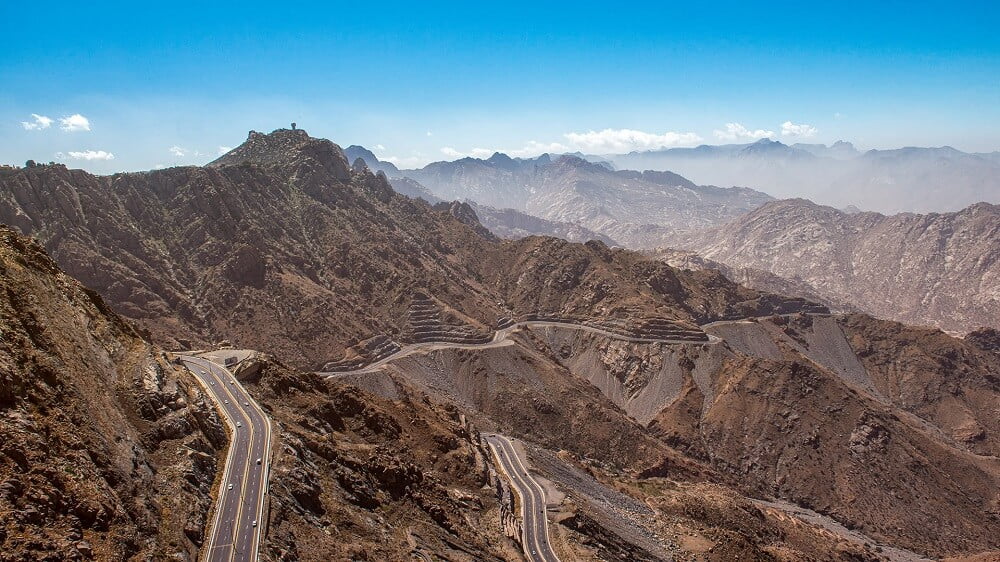
Route 40 climbs 1,700 meters in elevation over the final third of the Jeddah–Taif corridor, more vertical gain than any other paved road in western Saudi Arabia. The highway departs the coastal plain at Bahrah, where the escarpment rises abruptly from the desert floor, then threads through a series of tunnels and exposed granite shoulders before reaching the plateau city. The ascent begins gradually—flat stretches interrupted by long, banked curves—then tightens into the Al-Hada pass, where the roadway doubles back on itself in hairpin turns visible from kilometers away. The distance between Jeddah and Taif translates to roughly two hours under optimal conditions: early morning departures before 7:00 AM and late evening runs after 9:00 PM move at highway speed with minimal braking. Midday and weekend traffic compresses the mountain section into stop-and-go segments, particularly near the observation platforms where vehicles pull off for photographs of the valley below. Heavy trucks ascending the grade occupy the right lane continuously, forcing passenger vehicles into the left lane for extended stretches. The road surface itself is smooth asphalt with reflective lane markers and periodic rest areas equipped with fuel stations and convenience stores. Fog is the primary variable affecting the journey. Winter months bring low clouds that settle onto the pass, reducing visibility to 50 meters and requiring headlights and hazard signals even at midday. Summer heat creates the opposite problem: pavement temperatures above 50°C stress tires and cooling systems, prompting roadside stops for vehicles not serviced before departure. The Saudi Ministry of Transport monitors the route continuously, deploying maintenance crews to clear rockfall and repair guardrails damaged by heavy trucks navigating the switchbacks. Private car transfers eliminate the navigation and fatigue variables for first-time travelers. Licensed operators based in Jeddah provide sedan and SUV service with fixed-rate pricing, collecting passengers from hotels or the airport and delivering them directly to Taif accommodations. The vehicles are equipped with air conditioning, phone charging ports, and drivers familiar with alternate routes when the main highway experiences congestion or weather delays. Self-drive travelers should verify tire condition, brake responsiveness, and coolant levels before departure—the mountain descent on the return journey tests all three systems harder than any coastal highway.
“Route 40 climbs 1,700 meters in elevation over the final third of the corridor, more vertical gain than any other paved road in western Saudi Arabia.”
The journey between Jeddah and Taif primarily utilizes Route 40, known as Al-Hada Road. This mountain route connects the coastal plain to the highlands via a series of steep, winding passes.
Route 40/Al-Hada Road
Route 40/Al-Hada Road
Route 40/Al-Hada Road
Drivers should maintain steady speeds and monitor vehicle cooling systems during the mountain ascent. Arriving between 06:00 and 10:00 helps avoid heavy traffic and high temperatures on the road.
The optimal time to travel between Jeddah and Taif is the 06:00–10:00 window. Adhering to this arrival recommendation allows travelers to bypass peak traffic congestion and avoid the intense midday heat experienced along the mountain passes.
30°C to 38°C; high heat. Plan for early morning departures to mitigate road temperatures.
15°C to 25°C; mild conditions. These months offer the most comfortable driving experience.
—; stable conditions. This period provides the most efficient travel time for the route.
Verdict: The best time for this journey is during the 06:00–10:00 window on a weekday during the milder months of October or April.
The route between Jeddah and Taif via the Al-Hada Road remains accessible to travelers 24 hours a day, seven days a week.
Prepare your vehicle and documents before tackling the 167 km mountain route between Jeddah and Taif.
Everything you need to know about distance between jeddah and taif
The distance between jeddah and taif is approximately 170 kilometers via the Al-Hada mountain road. This route serves as the primary connection for those traveling from the coast to the highlands.
Travel time varies based on traffic, but the journey typically takes between 2.5 to 3 hours. Understanding the distance between jeddah and taif helps in planning necessary breaks during the climb.
The best arrival window is 06:00–10:00 to avoid peak traffic and extreme midday heat on the mountain passes. Planning your departure to align with this window ensures a smoother transition through the terrain.
There is an entry fee of 0 SAR for this journey as the Al-Hada road is a public route. You do not need to purchase tickets for the passage itself regardless of when you travel.
The mountain pass features steep inclines and sharp bends, requiring cautious driving. While the infrastructure is well-maintained, drivers should remain vigilant while navigating the varying elevation between jeddah and taif.
Yes, many visitors prefer private transfers to navigate the mountain roads comfortably. These services allow travelers to focus on the scenery while experienced drivers handle the logistics of the trip.
The route remains open 24 hours a day, meaning you can technically drive at any time. However, following the recommended arrival window helps you bypass potential congestion on this popular mountain path.